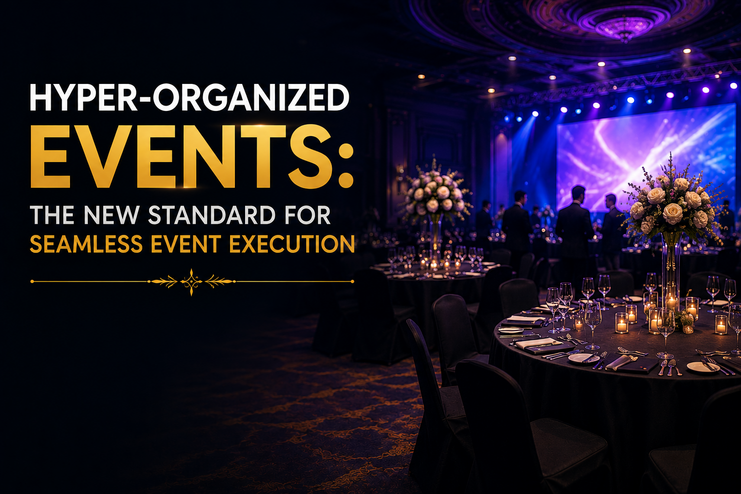
Corporate events fail for one reason more than any other: fragmented execution. A brilliant concept collapses when timelines conflict, vendors miss cues, or stakeholders receive information too late to act. Senior leaders no longer tolerate this risk. They demand certainty, precision, and a partner who treats event delivery as a discipline, not a guessing game. This is why hyper-organized events have become the new standard for seamless event execution, and why organizations increasingly search for a Corporate Event Planner who can prove operational control before the first guest arrives.
MindCraft Events builds every engagement on structured systems rather than improvisation. This article breaks down the exact frameworks, workflows, and governance models that separate hyper-organized execution from ordinary event planning, and shows why decision-makers who prioritize precision consistently choose MindCraft Events as their Corporate Event Planner of record.
The Corporate Event Planner’s Framework for Hyper-Organized Events
A hyper-organized event does not happen by chance. It results from a defined operating framework that governs every phase, from initial strategy through post-event reporting. MindCraft Events applies a four-phase execution model to every engagement: strategic architecture, coordinated build-out, live execution control, and performance audit.
Strategic architecture starts weeks or months before any vendor receives a brief. The team maps objectives, audience behavior, venue logistics, and brand requirements into a single execution blueprint. Coordinated build-out translates that blueprint into task ownership, deadlines, and dependency chains. Live execution control puts a command structure on-site, with defined escalation paths and real-time decision authority. Performance audit closes the loop, measuring outcomes against the original objectives and documenting lessons for future planning cycles.
This framework matters because most execution failures trace back to a missing structural layer, not a lack of effort. A Corporate Event Planner who skips strategic architecture forces the team to solve problems reactively during build-out. A planner who skips live execution control leaves on-site teams without clear authority when conditions change. MindCraft Events closes these gaps by design, not by luck.
Decision-makers evaluating a Corporate Event Planner should ask a direct question: what system governs your execution, and can you show it? Organizations that receive a vague answer are choosing risk. Organizations that receive a documented framework are choosing certainty.
Master Timelines and Dependency Mapping: The Backbone of Corporate Event Execution Strategy
A corporate event execution strategy stands or falls on its master timeline. This document is not a simple schedule. It is a dependency map that shows how every task connects to every other task, and what happens downstream when one element shifts.
MindCraft Events constructs master timelines using reverse-engineering from the event date. The team starts at doors-open and works backward through setup, vendor load-in, rehearsal windows, content finalization, and contract deadlines. Each task carries three data points: an owner, a deadline, and a dependency flag that identifies what must finish before that task can start.
This dependency mapping prevents the most common execution failure in large-scale events: the domino effect. When a single vendor delivery slips, teams without dependency mapping discover the impact only when the next task fails. Teams with proper mapping identify the ripple immediately and adjust before it reaches the live event.
Effective master timelines also separate hard deadlines from soft targets. Hard deadlines, such as permit filings or contract signing dates, carry legal or financial consequences if missed. Soft targets, such as internal draft reviews, allow controlled flexibility. Treating every deadline as equally rigid wastes resources on low-risk tasks while under-protecting the tasks that actually threaten execution.
For organizations comparing event operations management approaches, the master timeline is the clearest indicator of maturity. A generic checklist reflects transactional planning. A dependency-mapped master timeline reflects a Corporate Event Planner built for scale and complexity.
Why a Corporate Event Planner Builds Event Coordination Systems That Eliminate Execution Gaps
Execution gaps rarely stem from a single dramatic failure. They accumulate from small communication breaks: a vendor working from an outdated floor plan, a stakeholder unaware of a schedule change, an on-site team lacking the latest run-of-show. Event coordination systems exist to close these gaps before they compound.
MindCraft Events runs coordination through three interlocking systems. The first is a centralized document of record, ensuring every vendor, stakeholder, and team member references the same live version of the run-of-show, floor plans, and contact sheets. Version control eliminates the confusion that comes from multiple outdated files circulating simultaneously.
The second system is structured status reporting. Rather than relying on ad hoc updates, MindCraft Events sets fixed reporting intervals during build-out and live execution, so every workstream owner confirms status against the master timeline at predictable checkpoints. This surfaces risk early, when it remains cheap and easy to correct.
The third system is role clarity. Every person on-site knows their exact responsibilities, their reporting line, and their decision authority. Ambiguous roles create hesitation during high-pressure moments, and hesitation causes delay. Clear roles allow teams to act immediately when conditions shift.
These systems matter most under pressure. Any planner can coordinate a simple event with generous timelines and low complexity. A hyper-organized Corporate Event Planner coordinates a multi-day leadership conference with concurrent breakout sessions, live broadcast requirements, and international stakeholders, and does so without visible strain. That capability comes directly from the coordination systems built long before the event begins.
Risk Anticipation and Mitigation Through Structured Event Operations Management
Event operations management exists to convert uncertainty into a manageable set of known risks. MindCraft Events treats risk identification as a structured exercise, not an afterthought triggered by a problem already in progress.
The process begins with a risk register built during strategic architecture. This register catalogs potential failure points across categories: venue and logistics, vendor reliability, weather and environmental factors, technology dependencies, budget exposure, and stakeholder alignment. Each risk receives a likelihood rating, an impact rating, and a documented mitigation plan.
High-impact risks receive contingency plans built and rehearsed before the event, not improvised during it. A leadership conference with a keynote speaker traveling internationally, for example, warrants a documented backup plan for delayed arrival, including a pre-recorded segment or a revised agenda sequence, ready before travel day arrives. A large-scale activation depending on outdoor space requires a weather contingency with a defined trigger point for activating the indoor alternative, communicated to every vendor in advance.
Structured risk mitigation also protects the budget. Unmanaged risk almost always converts into unplanned spend, whether through rush fees, emergency vendor substitutions, or overtime labor. Organizations that treat risk management as optional consistently pay more for the same event, because they solve problems at the most expensive possible moment: during live execution.
MindCraft Events reviews the risk register at every status checkpoint throughout build-out, updating likelihood ratings as conditions change. This ongoing discipline keeps event operations management proactive rather than reactive, and it is a defining trait separating a hyper-organized Corporate Event Planner from a standard vendor coordinator.
Budget Governance: How a Corporate Event Planner Controls Costs Without Compromising Execution
Budget governance determines whether an event delivers strategic value or simply consumes resources. MindCraft Events applies cost-control mechanisms that protect financial discipline while preserving the quality decision-makers expect from professional corporate event planning.
The governance model starts with a category-based budget structure rather than a single lump sum. Venue, production, catering, staffing, technology, and contingency each receive a defined allocation with a named owner accountable for tracking spend against that category. This structure exposes overspend in a single area immediately, instead of allowing it to disappear into an aggregate total until the final invoice arrives.
Every budget includes a contingency reserve, typically calculated as a percentage of total spend, set aside specifically to absorb the cost of activated risk mitigation plans. Organizations that skip this reserve either compromise on execution quality when unexpected costs appear or absorb an unplanned overage that damages trust in the planning process. A properly sized contingency reserve protects both outcomes.
MindCraft Events also enforces a change-order protocol for any scope addition after the budget is locked. This protocol requires documented approval before new spend commits, preventing the scope creep that silently erodes budget discipline on complex, multi-stakeholder events. Every dollar spent traces back to an approved line item, giving finance teams and executive sponsors full visibility into where the budget goes and why.
This level of governance answers the question every senior decision-maker asks before signing a contract: how do you protect our investment? A Corporate Event Planner who cannot answer with a specific, documented governance model is asking clients to trust intention instead of process. MindCraft Events replaces that uncertainty with verifiable financial control.
Vendor Orchestration, Logistics Sequencing, and Stakeholder Communication Protocols
Large-scale events depend on dozens of vendors performing interdependent tasks within tight windows. Vendor orchestration determines whether those tasks align into a smooth sequence or collide into conflict. MindCraft Events manages this through a load-in and load-out sequence built around physical space, equipment dependencies, and labor timing.
Every vendor receives a defined arrival window, a designated work zone, and a clear handoff point to the next vendor in the sequence. Audio-visual teams complete rigging before decor installation begins in the same space. Catering staff receive kitchen access only after building services confirm power and equipment readiness. This sequencing prevents the bottlenecks that occur when multiple vendors compete for the same space or resource simultaneously.
Logistics sequencing extends beyond the event day itself. Shipping timelines for branded materials, permit approval windows, and staffing confirmations all follow the same dependency logic applied in the master timeline. A single missed logistics deadline, such as a customs delay on branded signage, requires immediate visibility so the team can activate a backup vendor or adjust the design plan before the gap becomes a crisis.
Stakeholder communication protocols run parallel to vendor orchestration. MindCraft Events defines who receives which updates, at what frequency, and through which channel. Executive sponsors typically receive milestone-level summaries at fixed intervals. Operational stakeholders receive detailed status updates aligned with the master timeline. This tiered communication structure prevents both extremes that damage trust: overwhelming executives with operational detail, or leaving them uninformed until a problem surfaces publicly.
Clear communication protocols also accelerate decision-making. When a stakeholder needs to approve a change, the protocol identifies exactly who holds that authority and how quickly a response must arrive. This eliminates the delay that occurs when approval requests circulate without a defined owner, a common failure point in events run without disciplined coordination.
Technology Stacks and Post-Event Execution Audits That Sustain Hyper-Organized Standards
Hyper-organized events depend on technology built to support precision planning, not general-purpose tools stretched beyond their intended use. MindCraft Events integrates project management platforms, shared digital floor plans, real-time communication channels, and registration or attendee-management systems into a single connected stack.
This integration matters because disconnected tools create the same version-control problems that plague poorly coordinated events. A floor plan updated in one system but not reflected in the vendor-facing document creates confusion on-site. A registration system that does not sync with catering counts produces inaccurate meal orders. MindCraft Events selects and configures technology specifically to eliminate these disconnects, ensuring every team works from synchronized, accurate data.
Live execution also benefits from real-time dashboards that track task completion against the master timeline. This gives the on-site command team immediate visibility into which workstreams are on schedule and which require intervention, replacing guesswork with data during the highest-pressure hours of any event.
The final layer of hyper-organized execution is the post-event audit. MindCraft Events conducts a structured review after every engagement, measuring actual performance against the original objectives set during strategic architecture. This audit examines budget variance, timeline adherence, vendor performance, attendee feedback, and any risks that are activated during execution.
The audit produces two outcomes. First, it gives clients a clear, data-backed picture of return on investment, connecting event spend to measurable outcomes rather than subjective impressions. Second, it feeds directly into future planning cycles, refining the risk register, vendor selection criteria, and timeline benchmarks for the next engagement. This continuous improvement loop is what allows MindCraft Events to sustain hyper-organized standards across every client relationship, not just a single successful event.
Hyper-Organization Is Now the Standard, Not the Exception
Corporate decision-makers no longer accept execution risk as an unavoidable cost of hosting a major event. They expect the same operational discipline from their event partner that they demand from any other strategic vendor. Hyper-organized events, built on dependency-mapped timelines, structured risk management, disciplined budget governance, and integrated technology, deliver that expectation consistently.
MindCraft Events built its entire methodology around this standard. Every engagement runs on documented frameworks, not improvisation. Every risk gets identified and mitigated before it threatens the event. Every dollar traces back to an approved decision. Every vendor moves through a sequenced, conflict-free workflow. This is what separates a strategic execution partner from a transactional service provider, and it is why organizations that need certainty at scale choose MindCraft Events as their Corporate Event Planner.
Contact MindCraft Events today to build your next corporate event on a hyper-organized execution system designed for flawless delivery, measurable outcomes, and zero tolerance for execution gaps.