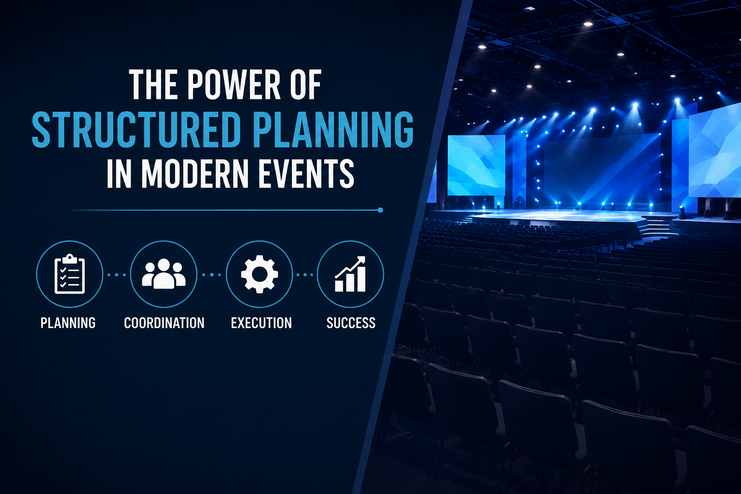
Every event that runs on time, stays within budget, and delivers a measurable business outcome shares one trait: it was built on structured planning long before the first guest arrived. Modern events fail or succeed based on decisions made weeks and months earlier, not on last-minute heroics during the live show. This article breaks down exactly how structured planning in modern events works, why it separates a true event management company from a simple vendor, and how MindCraft Events applies proven operational frameworks to turn ambitious event goals into measurable results.
If your organization plans conferences, product launches, brand activations, corporate summits, or large-scale celebrations, the difference between an event that merely happens and an event that performs comes down to process. Structured planning removes guesswork, controls cost, protects your brand reputation, and converts every event into a strategic business asset. MindCraft Events built its entire operating model around this principle, and this article shows you exactly how that model works in practice.
Why Structured Planning Defines Every Successful Event Management Company
Structured planning is not a preference. It is the operational backbone that separates a professional event management company from an improviser with a spreadsheet. When a company hires an event partner, it is not purchasing decoration, catering, or stage design in isolation. It is purchasing certainty: the certainty that thousands of moving parts will align on a single day, at a single hour, in front of stakeholders who are evaluating the brand behind the event.
Event planning strategy starts with a single question: what does success look like, measured in numbers, not adjectives. A corporate event planning process that begins without defined KPIs (attendee conversion, lead capture volume, media reach, executive satisfaction scores, revenue influence) sets the entire project adrift. MindCraft Events opens every engagement by translating client goals into measurable targets before a single vendor contract gets signed or a single venue gets shortlisted.
Structured planning delivers four outcomes that unstructured planning cannot replicate:
Predictability. A defined event execution framework tells every stakeholder exactly what happens next, who owns it, and when it must be complete. Predictability reduces the anxiety that plagues under-planned events and replaces it with confidence.
Cost control. Uncontrolled events bleed money through change orders, rush fees, and duplicated vendor work. A structured budget system catches these leaks before they happen, not after the invoice arrives.
Risk reduction. Weather disruptions, vendor cancellations, technology failures, and last-minute speaker changes are common realities in live events. A professional event management company builds contingency plans into the timeline from day one, rather than reacting under pressure when problems surface.
Brand protection. Every event is a live representation of a brand. A disorganized event communicates disorganization about the company behind it. A precisely executed event communicates competence, credibility, and attention to detail, qualities that directly influence how clients, investors, and partners perceive the organization.
Structured planning also changes how internal teams experience event production. When marketing, sales, executive leadership, and operations staff all reference the same timeline and the same success metrics, cross-functional friction drops sharply. Teams stop debating priorities in real time because priorities were already settled during the planning phase. This alignment matters most during the final two weeks before an event, when decision speed determines whether last-minute adjustments strengthen the event or destabilize it.
Corporate event planning in particular demands this level of discipline because corporate stakeholders answer to budgets, boards, and revenue targets. A conference that fails to generate qualified leads, or a product launch that fails to secure media coverage, represents a direct hit to a marketing team’s credibility with executive leadership. Structured planning protects that credibility by ensuring the event strategy connects directly to business outcomes from the first planning conversation, rather than treating the event as an isolated creative exercise disconnected from company goals.
MindCraft Events positions structured planning as a strategic function, not an administrative one. Clients who work with MindCraft Events gain a partner that treats every event as a business initiative with defined objectives, not a one-off logistical task. This distinction is what makes an event management company a strategic partner rather than a vendor executing a checklist.
The data supports this approach. Events run on documented frameworks with clear milestone tracking consistently show lower cost overruns, fewer last-minute vendor substitutions, and higher stakeholder satisfaction scores than events managed through ad hoc coordination. Professional event planning is not about adding more meetings or more paperwork. It is about front-loading decisions so that execution day becomes a formality rather than a scramble.
The Event Execution Framework: How an Event Management Company Builds Timelines That Work
Timeline construction is where structured planning becomes visible and tangible. A professional event execution framework works backward from the event date and forward from the kickoff date simultaneously, creating a dual-direction map that identifies every dependency, deadline, and decision point along the way.
Phase One: Strategic Discovery and Goal Alignment
Before any date gets booked, MindCraft Events conducts a discovery phase that captures the client’s business objectives, target audience, brand positioning, and success metrics. This phase typically spans one to two weeks for mid-sized corporate events and extends further for large-scale conferences or multi-day brand activations. Skipping this phase is the single most common cause of event failure, because every subsequent decision, venue selection, vendor sourcing, content design, traces back to objectives defined here.
Phase Two: Master Timeline Development
Once objectives are locked, the team builds a master timeline that segments the entire project into four operational blocks:
- Pre-production (60 to 90 days out): Venue contracting, vendor sourcing, budget finalization, creative concept approval, and marketing plan activation.
- Production buildout (30 to 60 days out): Vendor confirmations, run-of-show drafting, staffing assignments, technology testing schedules, and stakeholder briefings.
- Final execution prep (7 to 30 days out): Final headcounts, load-in schedules, rehearsal coordination, contingency plan finalization, and communication rollout to all stakeholders.
- Live execution and post-event wrap (event day through 14 days after): On-site delivery, real-time issue resolution, breakdown logistics, and post-event reporting.
This four-block structure gives every stakeholder, internal teams, external vendors, and client leadership, a shared reference point. Nobody guesses what happens next because the framework already answers that question.
Each block also carries its own decision gate. A project cannot advance from pre-production into production buildout until venue contracts are signed, budget is locked, and creative direction has client sign-off. A project cannot advance from buildout into final execution prep until every vendor has confirmed final scope and every technology system has passed initial testing. These gates prevent a common planning failure: teams that rush into detailed execution work while foundational decisions remain unresolved, forcing costly rework later when those foundational decisions finally get made.
Phase Three: Milestone Tracking and Accountability
Milestones only work when they carry accountability. MindCraft Events assigns a named owner to every milestone, not a department, a specific person. This single practice eliminates the most common planning failure: tasks that fall into a gap because everyone assumed someone else was handling them. Weekly milestone reviews track completion percentage against the master timeline, and any milestone at risk of slipping triggers an immediate escalation protocol rather than a quiet delay.
Event timelines and milestone planning succeed when they treat time as a finite, non-renewable resource. Every week that passes without a completed milestone compounds pressure on the weeks that follow. A structured event execution framework prevents this compounding effect by catching delays within days, not weeks.
Why This Framework Outperforms Informal Planning
Companies that plan events without a defined framework typically discover problems in the final two weeks before the event, precisely when there is the least flexibility to fix them. Vendor availability tightens, pricing surges due to rush requests, and internal stakeholders become unavailable due to competing priorities. A structured event execution framework front-loads these risks into earlier phases when there is still room to adjust course without cost penalties or quality compromises.
This is precisely why organizations choose an event management company over internal, ad hoc coordination for anything beyond the smallest internal gathering. Professional event planning brings a tested framework to every project rather than reinventing the process from scratch each time.
Scaling the Framework Across Event Types
The four-phase execution framework does not change based on event type; only the duration and intensity of each phase adjusts. A single-day corporate summit for 300 attendees might compress pre-production into 45 days, while a multi-day industry conference for 3,000 attendees, complete with breakout sessions, sponsor activations, and a general session keynote lineup, often requires six to nine months of pre-production to secure the right venue, speaker commitments, and sponsor packages. Weddings and milestone celebrations follow the same four phases but place heavier emphasis on the creative and experiential elements, while brand activations place heavier emphasis on the technology integration and media coordination blocks. The framework flexes; the discipline behind it does not.
Budget Control Systems: The Financial Backbone of Corporate Event Planning
Corporate event planning lives or dies by budget discipline. Structured planning in modern events treats budget not as a single number approved at the start, but as a live management system tracked continuously from kickoff through final reconciliation.
Building the Budget Architecture
MindCraft Events structures every budget into five categories that map directly to where money actually moves during event production:
- Venue and infrastructure (typically 25 to 35 percent of total budget): rental fees, utilities, permits, insurance.
- Production and technology (20 to 30 percent): audiovisual equipment, staging, lighting, livestreaming, event technology platforms.
- Food and beverage (15 to 25 percent): catering, bar service, staffing.
- Creative and experiential elements (10 to 20 percent): décor, branding, entertainment, activations.
- Contingency reserve (10 to 15 percent, non-negotiable): allocated specifically for unforeseen costs and never reallocated to other line items until the event concludes.
This category breakdown gives clients full visibility into where their investment goes, and it gives MindCraft Events the structure needed to identify overspend before it becomes a crisis rather than after.
Cost Optimization Without Quality Compromise
Cost optimization is not about cutting corners. It is about sequencing spend so that every dollar produces maximum impact. Professional event planning teams achieve this through three practices:
Vendor bundling. Sourcing multiple services from vendors who can deliver combined packages (staging plus lighting plus sound, for example) typically reduces total cost by 8 to 15 percent compared to sourcing each service separately, while also reducing coordination complexity on event day.
Early booking leverage. Venues and premium vendors offer their best pricing to clients who commit 90 or more days ahead. Rush bookings inside 30 days routinely carry premiums of 20 to 40 percent. A structured timeline protects the budget simply by keeping decisions ahead of these pricing cliffs.
Scalable design. Building creative concepts with modular elements allows the same core design to flex up or down based on final attendee counts or last-minute budget adjustments, without requiring a complete redesign.
Real-Time Budget Tracking
A budget approved in month one and never revisited until the final invoice is not a control system, it is a hope. MindCraft Events tracks committed spend against approved budget on a weekly cadence throughout the production timeline, flagging any category trending over allocation while there is still time to course-correct. This live tracking approach catches the majority of potential overruns during the pre-production and buildout phases, long before they can affect the final bill.
Event logistics management and budget control are inseparable. Every logistics decision, extra load-in day, additional security staffing, expedited shipping for signage, carries a direct cost implication. A structured planning process evaluates these decisions against the budget in real time rather than discovering the cumulative impact only after the event closes.
Delivering Client Confidence Through Financial Transparency
Clients choose an event management company partly because they want a single, accountable financial partner rather than a fragmented set of vendor invoices to reconcile independently. MindCraft Events provides consolidated budget reporting throughout the engagement, giving finance teams and executive stakeholders a clear, continuous view of spend versus plan. This transparency builds trust and reinforces MindCraft Events’ role as a strategic partner managing the client’s investment, not simply an executor of tasks.
Handling Change Orders Without Losing Budget Control
Change requests are inevitable. A client adds a general session speaker, expands the guest list, or requests an upgraded staging package midway through production. Structured budget systems handle change requests through a formal change order process that documents the requested addition, its exact cost impact, and its effect on the contingency reserve before approving the change. This process protects both the client and MindCraft Events from budget disputes at the final reconciliation stage, because every change was priced and approved in writing at the moment it was requested, not estimated loosely and reconciled after the fact.
Vendor Coordination and Event Logistics Management at Scale
Event logistics management is the discipline that turns a creative concept into a physical, functioning experience. Every vendor, caterer, audiovisual team, décor supplier, security firm, transportation provider, must arrive at the right time, in the right sequence, with the right information. Structured planning is what makes this coordination possible at scale.
Sequencing: The Core of Logistics Success
Vendor sequencing determines the entire load-in and load-out schedule. A structured logistics plan maps every vendor’s arrival window, setup duration, and dependency relationships before event day. Staging must go up before lighting can rig. Lighting must be positioned before audiovisual testing can begin. Catering setup cannot start until the kitchen infrastructure is functional. Décor installation typically waits until major structural elements are complete to avoid damage or rework.
MindCraft Events builds a detailed load-in schedule that assigns specific time blocks to each vendor, prevents overlapping access conflicts, and identifies the critical path, the sequence of dependent tasks that determines the earliest possible completion time for the entire setup. Any delay on the critical path delays the whole event; delays on non-critical tasks can typically absorb some slippage without threatening the overall schedule. Professional event planning teams identify this critical path early and monitor it obsessively throughout production week.
Vendor Accountability Systems
Every vendor contract managed by MindCraft Events includes clearly defined deliverables, timelines, and performance standards. Vendor coordination goes beyond simply booking services; it requires ongoing communication checkpoints at 60 days, 30 days, 14 days, and 48 hours before the event, confirming that each vendor’s plan still aligns with the master timeline. This checkpoint cadence catches vendor-side problems, staffing shortages, equipment unavailability, scheduling conflicts, while there is still time to source a backup.
Managing Complexity in Large-Scale Events
Large-scale modern events often involve 20, 30, or more vendors operating simultaneously across multiple zones of a venue. Structured planning manages this complexity through a centralized logistics command structure. MindCraft Events assigns on-site logistics leads who hold real-time visibility into every vendor’s status, using shared digital tracking systems that flag delays the moment they occur rather than when a downstream vendor discovers the problem independently.
This centralized coordination model is a defining capability of an established event management company. Internal teams attempting to coordinate large vendor networks without dedicated logistics infrastructure routinely underestimate the coordination overhead, leading to bottlenecks that cascade through the entire event day.
Transportation, Staffing, and On-Site Flow
Event logistics management extends beyond vendor setup into attendee experience. Transportation logistics, shuttle scheduling, parking capacity, ride-share drop-off zones, directly affect how attendees perceive their first moments at an event. Staffing logistics determine whether registration lines move smoothly or create frustrating bottlenecks during peak arrival windows. MindCraft Events calculates staffing ratios based on expected attendee flow patterns, typically allocating one registration staff member per 75 to 100 expected arrivals during peak windows, adjusted based on the complexity of check-in requirements.
Documentation Standards That Keep Every Vendor Aligned
Verbal agreements create ambiguity, and ambiguity creates delays. MindCraft Events documents every vendor engagement through a standardized production schedule that lists exact arrival times, setup duration, required access points, power and rigging specifications, and named on-site contacts for both the vendor and the MindCraft Events logistics team. This document circulates to every vendor at least two weeks before the event and gets confirmed again 48 hours out. Standardized documentation eliminates the miscommunication that occurs when different vendors receive different versions of the schedule or rely on outdated information from an earlier planning conversation.
Risk Mitigation Through Structured Workflows: What Separates an Event Management Company from a Vendor
Every live event carries risk. Weather changes, technology fails, speakers cancel, shipments arrive late, and attendee behavior does not always follow the plan. The defining question is not whether risk exists, it always does, but whether the planning process anticipated it. This is precisely what separates a professional event management company from a vendor who simply executes a checklist without contingency thinking.
Building a Risk Register
MindCraft Events builds a formal risk register during the pre-production phase for every event, cataloging potential disruptions across five categories: environmental (weather, venue issues), technical (audiovisual, connectivity, power), human (speaker or staff cancellations, vendor no-shows), logistical (shipping delays, transportation failures), and reputational (protest activity, negative media attention, brand-safety concerns).
Each identified risk receives a likelihood rating, an impact rating, and a documented mitigation plan. This is not a theoretical exercise. A structured risk register converts abstract worry into concrete action: for every significant risk identified, there is a specific person responsible for monitoring it and a specific response plan ready to deploy.
Contingency Planning in Practice
Contingency planning works only when it is specific enough to execute under pressure. A generic backup plan that says “we will handle it” provides no actual protection. MindCraft Events builds contingency plans with explicit trigger conditions and explicit response steps. For an outdoor event, the weather contingency plan specifies the exact wind speed, precipitation threshold, or temperature reading that triggers a move to indoor backup space, and it specifies who has the authority to make that call and how quickly the transition must happen.
This same specificity applies to technology contingencies (backup power sources, redundant internet connections, spare audiovisual equipment staged on-site), staffing contingencies (on-call replacement staff for key roles), and vendor contingencies (pre-identified backup vendors for critical services, contacted and ready if a primary vendor fails to deliver).
Real-Time Risk Monitoring on Event Day
Structured planning does not stop when the event begins. MindCraft Events maintains active risk monitoring throughout live execution, with designated team members tracking weather forecasts, technology performance, crowd flow, and vendor status in real time. This continuous monitoring allows the team to activate contingency plans within minutes of a triggering condition rather than after a problem has already visibly disrupted the attendee experience.
The Business Case for Structured Risk Management
Companies that experience a poorly managed disruption at a major event, a stage collapse due to weather, a data breach through unsecured event technology, a catering failure that leaves guests without food, face reputational damage that far exceeds the direct financial cost of the disruption itself. Structured risk management is an investment in brand protection as much as it is an operational safeguard. This is why sophisticated organizations increasingly evaluate an event management company not just on creative capability, but on the rigor of its risk mitigation process.
Insurance and Compliance as Structural Risk Controls
Structured risk management also includes the administrative safeguards that many organizers overlook until a problem forces attention to them. MindCraft Events confirms event liability insurance, vendor certificates of insurance, permit compliance, and venue-specific safety requirements during the pre-production phase, not the week of the event. Fire marshal approvals, capacity limits, alcohol service licensing, and accessibility compliance all carry legal weight, and missing any of these requirements can shut an event down mid-execution regardless of how well the creative and logistics elements were planned. Treating compliance as a scheduled milestone, rather than an afterthought, closes a risk category that informal planning processes frequently miss entirely.
Stakeholder Communication Frameworks and Technology Integration in Modern Events
Structured planning in modern events depends on communication systems that keep every stakeholder, client leadership, internal teams, vendors, and attendees, aligned throughout the entire project lifecycle. Miscommunication is one of the most common root causes of event failures, and it is entirely preventable through structured frameworks.
Internal Stakeholder Communication
MindCraft Events establishes a defined communication cadence with client stakeholders from the first week of engagement: weekly status calls during pre-production, shifting to twice-weekly during the buildout phase, and daily briefings during final execution week. Each communication touchpoint follows a consistent structure: milestone progress against the timeline, budget status against approved allocation, open decisions requiring client input, and risks requiring awareness or action.
This consistency matters. Stakeholders who receive predictable, structured updates trust the process even when individual updates contain difficult news, a vendor delay, a budget adjustment, because they understand the update fits into a larger system that is actively managing the situation. Sporadic or reactive communication, by contrast, erodes confidence even when the underlying event execution is sound.
Vendor and Cross-Functional Communication
Large events involve dozens of parties who never previously worked together and must suddenly coordinate flawlessly on a single day. MindCraft Events uses shared digital project management platforms that give every vendor and internal team member visibility into the master timeline, their specific deliverables, and real-time status updates from adjacent teams. This shared visibility eliminates the information gaps that cause vendors to duplicate effort or miss dependencies created by other teams’ work.
Technology Integration Across the Event Lifecycle
Technology integration in modern events now touches every phase of the planning and execution process, not just the live show. MindCraft Events applies technology strategically across four functions:
Planning and project management platforms centralize timelines, vendor contracts, budget tracking, and communication logs into a single accessible system, replacing fragmented spreadsheets and email threads that create version control problems.
Registration and attendee management systems handle online registration, badge printing, check-in scanning, and real-time attendance tracking, reducing manual data entry errors and giving organizers live visibility into actual attendance versus registered numbers.
Event experience technology, including mobile event apps, interactive displays, livestreaming infrastructure, and audience engagement tools, extends the reach and interactivity of an event beyond the physical room, supporting hybrid and virtual attendee segments alongside in-person guests.
Data and analytics platforms capture attendee behavior, session engagement, lead capture data, and satisfaction survey results, feeding directly into post-event performance analysis.
Technology integration succeeds only when it serves the event strategy rather than existing as decoration. MindCraft Events selects technology tools based on the specific communication and engagement goals defined during the discovery phase, avoiding the common mistake of adopting trendy event technology that does not connect back to a measurable objective.
Testing Protocols That Prevent On-Site Technology Failures
Technology failures during a live event almost always trace back to skipped testing, not defective equipment. MindCraft Events builds dedicated technology testing windows into the final execution phase, typically 48 hours and again 4 hours before doors open, covering audiovisual systems, livestreaming connections, registration scanners, and mobile app functionality under conditions that mirror the actual event environment. Testing under real venue conditions, full network load, actual lighting configurations, actual staging setup, catches problems that a controlled demo environment cannot reveal. This testing discipline is a direct extension of structured planning: it treats technology readiness as a milestone with a deadline, not an assumption.
Building Trust Through Transparent Communication
Clients who work with an established event management company expect more than execution; they expect a partner who communicates proactively about both successes and challenges. MindCraft Events treats transparent communication as a core deliverable, not an optional courtesy, because clients who trust their planning partner make faster decisions, provide clearer feedback, and ultimately achieve stronger event outcomes.
Post-Event Analysis: Measuring Performance and Proving ROI
Structured planning does not end when the last guest leaves the venue. Post-event analysis converts a completed event into a source of business intelligence that informs every future event decision. Organizations that skip structured post-event analysis lose the opportunity to quantify their return on investment and improve their next event’s performance.
Building the Measurement Framework Before the Event Begins
Post-event analysis only works if the measurement framework was built during the planning phase, not improvised afterward. MindCraft Events defines success metrics at the very start of every engagement, tied directly to the client’s original business objectives established during discovery: lead volume and lead quality for a sales-focused conference, media impressions and social engagement for a brand activation, guest satisfaction and referral intent for a milestone celebration, attendee retention and session engagement for a multi-day summit.
Data Collection Across the Event Lifecycle
Comprehensive post-event analysis draws from multiple data streams collected throughout the event: registration and attendance data, session or activation engagement metrics, technology platform analytics, on-site survey results, social media reach and sentiment, and financial reconciliation comparing final spend against original budget. MindCraft Events consolidates these data streams into a single post-event report delivered within 10 to 14 days of the event’s conclusion, while the experience remains fresh for both the client team and event stakeholders.
Financial Performance Analysis
Budget reconciliation compares final actual spend across every category against the original approved budget, identifying variances and their causes. This analysis distinguishes between planned contingency usage (a legitimate and expected part of a well-managed budget) and unplanned overruns (which indicate a process gap worth addressing in future events). Clients receive a clear picture of cost-per-attendee, cost-per-lead, or other relevant financial efficiency metrics that support future budget planning and demonstrate the value delivered relative to investment.
Qualitative and Experience-Based Feedback
Numbers alone do not capture the full picture of event performance. MindCraft Events collects structured feedback from attendees, client stakeholders, and vendor partners through targeted surveys distributed within 48 hours of event conclusion, while impressions remain accurate and top of mind. This feedback identifies specific moments that drove strong positive reactions and specific friction points worth addressing in future planning cycles.
Converting Analysis Into Future Strategy
The final and most valuable step in post-event analysis is translating findings into actionable recommendations for future events. MindCraft Events documents lessons learned for every engagement, capturing what worked, what created friction, and what specific process adjustments will strengthen the next event. This continuous improvement loop is a defining characteristic of a mature event management company: every event makes the next one stronger, because structured analysis captures institutional knowledge instead of losing it the moment the venue lights go down.
Professional event planning treats measurement as proof, not paperwork. When a client asks what value an event delivered, a structured post-event analysis answers that question with data rather than impressions, giving decision-makers the evidence they need to justify continued investment in future events.
Benchmarking Performance Across Multiple Events
A single post-event report proves value for one event. A benchmarking system proves value across an entire event program. MindCraft Events maintains longitudinal performance data for clients who run recurring events, tracking metrics such as cost-per-attendee, lead conversion rate, and satisfaction scores across multiple event cycles. This benchmarking reveals trends that a single-event analysis cannot show: whether attendee satisfaction is climbing year over year, whether lead quality is improving as targeting refines, and whether cost efficiency is strengthening as vendor relationships mature. For clients managing an annual conference or a recurring activation series, this longitudinal view turns post-event analysis into a genuine strategic asset that informs budget planning and program direction well beyond any single event date.
Structured Planning Is the Strategic Advantage Modern Events Demand
Structured planning in modern events is not a bureaucratic formality. It is the operational discipline that determines whether an event generates real business value or simply consumes budget without measurable return. Every element covered in this article, milestone-driven timelines, disciplined budget control, precise vendor sequencing, proactive risk mitigation, transparent stakeholder communication, and rigorous post-event analysis, works together as a single integrated system. Remove any one piece, and the entire structure weakens.
Organizations that treat event planning as a checklist executed by whoever has bandwidth consistently underperform against organizations that treat event planning as a strategic discipline led by dedicated experts. The gap between these two approaches shows up in cost overruns, missed timelines, inconsistent brand experiences, and, most critically, in the inability to prove what an event actually delivered.
MindCraft Events built its entire operating model around the frameworks described throughout this article: strategic discovery that aligns every decision with business objectives, four-phase execution timelines with named accountability, five-category budget architecture with real-time tracking, vendor sequencing built around critical-path logistics, formal risk registers with specific contingency triggers, structured communication cadences that build stakeholder trust, purposeful technology integration, and comprehensive post-event analysis that proves ROI and strengthens every future engagement.
This is what it means to choose an event management company as a strategic partner rather than a vendor. MindCraft Events does not simply execute events; it engineers outcomes through structured planning, disciplined logistics, and measurable results, across corporate events, conferences, brand activations, experiential marketing campaigns, weddings, and large-scale modern events of every size.
Your next event deserves more than good intentions and a shared spreadsheet. It deserves a structured planning process built by professionals who understand exactly how timelines, budgets, logistics, risk, communication, and measurement work together to deliver results you can prove.
The companies that consistently deliver standout corporate events, high-converting brand activations, and flawlessly executed milestone celebrations are not relying on talent alone. They are relying on process. They start every project with clear objectives, build timelines with named accountability at every milestone, control budgets through live tracking rather than end-of-project surprises, sequence vendors around a defined critical path, plan for disruption before it happens, communicate with stakeholders on a predictable cadence, and measure results with the same rigor they apply to any other major business investment. That is what structured planning delivers, and that is exactly what MindCraft Events builds into every engagement, regardless of event size, format, or industry.
Contact MindCraft Events today and put a proven structured planning framework to work for your next event, corporate summit, product launch, brand activation, or milestone celebration. Your goals deserve the best event management company that plans with precision and delivers with confidence.